
In short
Common characteristics describe what several analyzed videos share: an angle, hook, action or demonstration structure. Compare them with the sources to distinguish the creative mechanism from details specific to one creator. Then retain the elements that genuinely fit your product.
Find characteristics
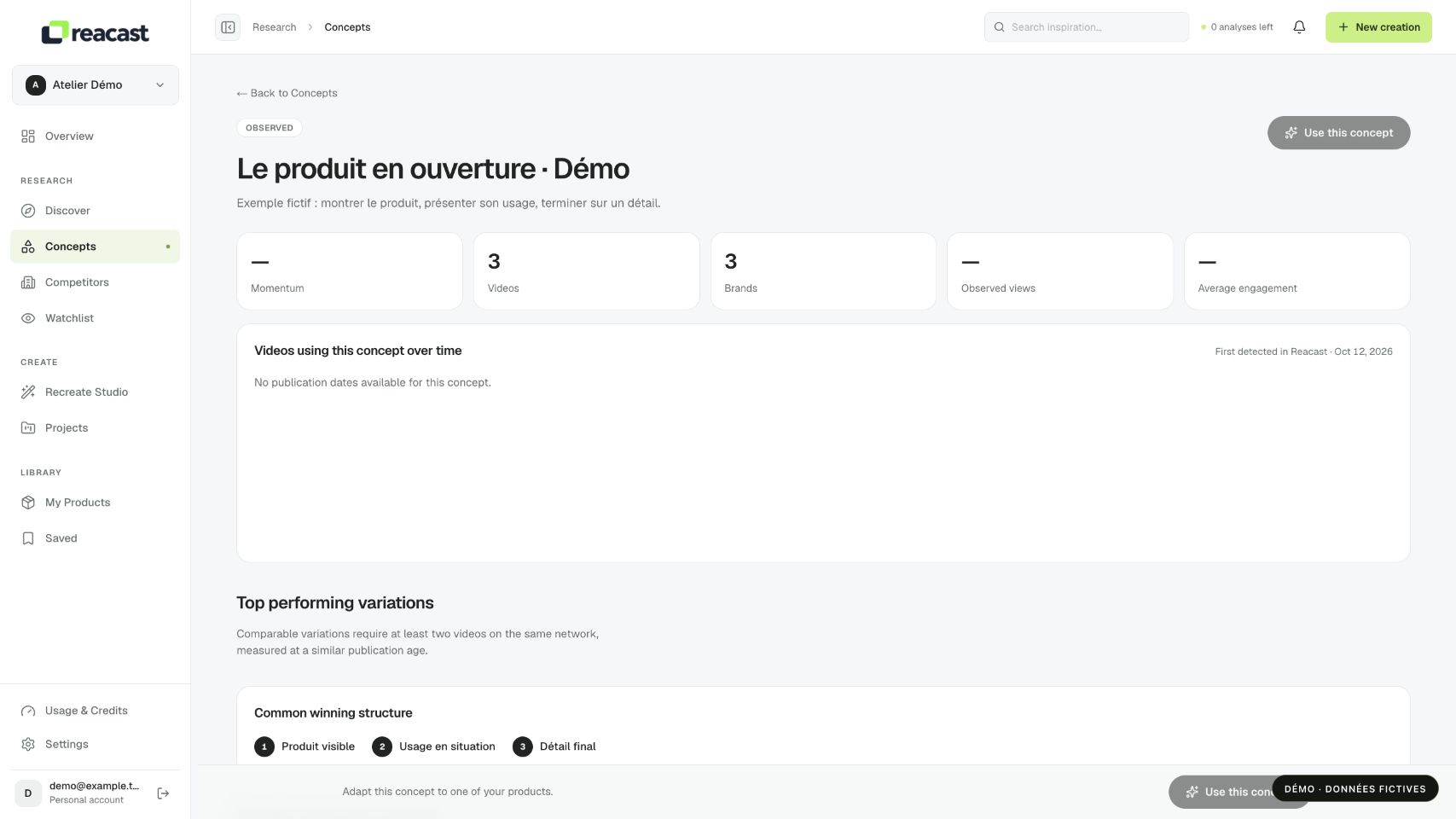
Open a Concepts detail page and read Common characteristics alongside the associated videos. Identify the product action, staging, hook and narrative progression mentioned.
Read these characteristics as a summary to check against cluster members. A short label may summarize several production choices; it does not necessarily describe every detail in every video. Opening references shows what is shared and what actually varies.
Check several videos
Watch at least two examples. Distinguish the shared structure from a prop, person or setting unique to one post. If a trait is not clearly visible, return to the relevant video analysis.
A private correction supports your workspace work; it does not automatically change observations in the shared catalog.
Distinguish structure from setting
Fictional example: three videos open on a visible problem, show a simple action and end on the result. One takes place in a kitchen, another in a car and a third at a desk. Problem–action–result may be their shared structure; the kitchen does not become a requirement of the concept.
If a cluster mentions a close-up demonstration, look at when it occurs and what it explains. For your product, preserve that explanatory purpose if relevant. Copying framing only because it appears in a highly viewed video does not establish its usefulness.
Adapt precisely
Keep the idea that explains the demonstration and adapt the facts to your product. An observed characteristic does not prove it causes performance. Do not attribute a commercial claim to your product unless you can verify it.
Before recreating, formulate the element to preserve as an action: “show the product in use from the opening” is more useful than “make a dynamic video.” You can then verify that intention in the chosen source and result without attributing an explanation to counters that they do not provide.